
The First World War
28 Jun 1914 World War I breaks out
TRIGGERING EVENT: assassination of Archduke Franz Ferdinand [1] (heir to the Austro-Hungarian throne)
28 Jul 1914 Austria declares war on Serbia. DOMINO EFFECT: Russia, France and Germany enter the war

1
31 Jul 1914 Austro-Hungarian general mobilization. 60,000 men from Trentino are called to the front
WHO ELSE JOINS THE WAR:
1914 Britain, Japan, Turkey
1915 Italy, Bulgaria, Romania
1917 United States, Greece, China

2
Circumstances in Italy before entering the war
1882 Signing of the Triple Alliance with Germany and Austria
BEFORE ENTERING THE WAR, DEBATE CENTERED AROUND TWO MAIN VIEWPOINTS:
INTERVENTIONISTS Nationalists. Only by entering the war against Austria
NEUTRALISTS Led by Giovanni Giolitti [3]. Only by not participating in the war
could Italy have recovered Trento and Trieste
The interventionists prevail because Antonio Salandra [2] is on their side, negotiating a secret agreement with France, Britain and Russia

3
26 Apr 1915 Italy joins the Triple Entente alongside France, England and Russia
24 May 1915 Italy declares war on Austria-Hungary. It was a monarchy commanded by King Vittorio Emanuele III [4] and by the Chief of Staff Luigi Cadorna [5], replaced in September 1917 following the defeat of Caporetto by Armando Diaz [6]

4

5

6
The Austro-Hungarian army
1867 The dual imperial and royal monarchy Austria-Hungary (Kaiserliche und Königliche, or KUK) is born. It is the result of a compromise between the Hungarian nobility and the Habsburg monarchy with Germany and Austria.
It is led by Emperor Franz Joseph I [7], who ascended the throne at the age of 18 and reigned from 1848 to 1916
armed forces “Viribus unitis” (i.e. united forces).
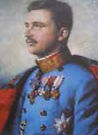
He was succeeded by his nephew Karl I [8] and Chief of Staff Franz Conrad Von Höezendorz [9].

7
8

9
FORTIFICATIONS AT THE SOUTHERN BORDERS
1914 Line of defense connecting a number of forts
They had existed since 1859 due to the defeat suffered by Austria in the Second War of Independence and the loss of Lombardy (1859). Among these was the Lardaro Fort barrier, also known as “Catenaccio delle Giudicarie”.
Before the war, the Austro-Hungarians retreated from the political border of Valle del Chiese to Lardaro because it was more easily defensible thanks to the system of fortifications.
24 May 1915 The Bersaglieri of the 45th Battalion enter the valley
1 Jun 1915 Storo and Condino are occupied
THE EVACUATION OF CIVILIANS WAS CARRIED OUT BY:
ITA Army --> 1,800 people from Brione and Condino sent to Piedmont
A-H Army --> 6,950 people sent from Cimego and Roncone to the Giudicariese hinterland
October/November 1915 TUSCAN BRIGADE and SICILY BRIGADE occupy Monte Melino and Monte Palone. The front remains unchanged on both sides. Trench warfare until the final day
Autumn/Winter 1915 Opposing artillery begin to face each other. Devastation of towns: no man’s land from Condino to Lardaro
ARMISTICE OF VILLA GIUSTI, signed on 3 Nov 1918
Establishes that on 4 Nov 1918 hostilities end
Austria-Hungary is defeated
Italy emerges victorious, gaining Trentino, Friuli Venezia Giulia and Istria
Later, ITA troops break through the Austro-Hungarian front and move towards Tione
Thousands of Austro-Hungarian prisoners descend Valle del Chiese to concentration camps scattered throughout Italy.